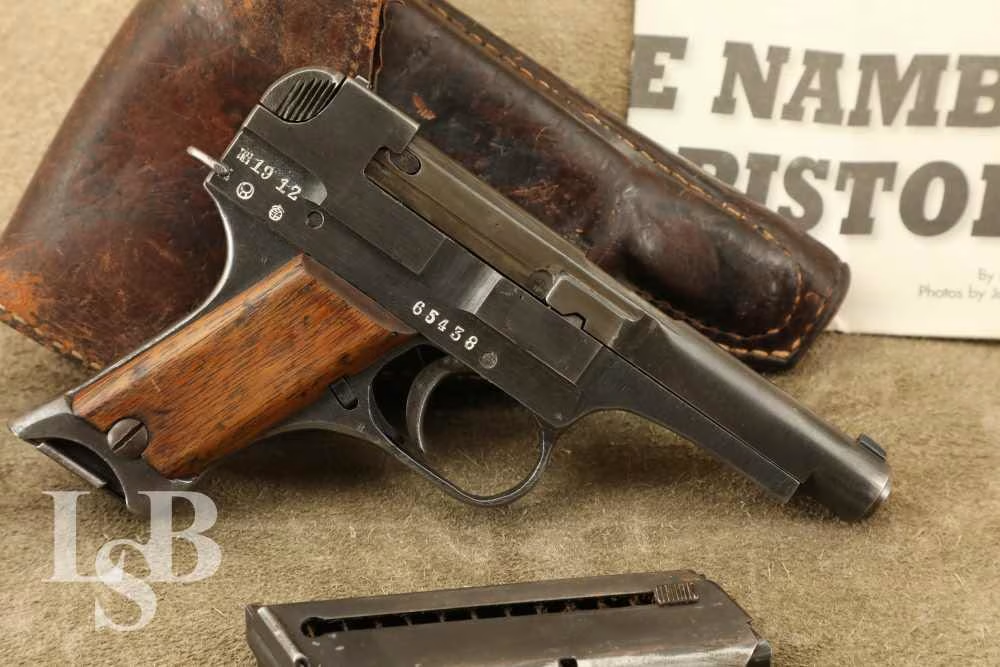
Japanese Nagoya Armory Type 94 Nambu 3 3/4” 8x22mm Pistol, 1937 C&R
SOLD FOR: $1,015.56
LSB#: LSB260503DF017
Make: Nagoya Armory, Japan
Model: Type 94
Serial #: 65438
Year of Manufacture: December 1937 / C&R
Caliber: 8x22mm Nambu
Action Type: Semi-automatic recoil operated locked breech pistol, fed by detachable magazines.
Markings: The left side of the frame is marked in right-to-left Kanji, “Kyuu Yon Shiki” (94 Type) and the frame by the safety selector is marked in Kanji, “An” (Safe) and, “Hi” (Fire). The right side of the frame is marked with the date, “19 12” and the Nagoya arsenal mark followed by the serial number, “65438”. The firing pin, firing pin block, locking block, and grips are not serialized. All other parts are serial matched to the frame. There are various small station marks throughout. The magazines are not serial matched to the frame.
Barrel Length: Approximately 3 3/4”
Sights/ Optics: The front sight is a blade fixed to the barrel shroud. The rear sight is a square notch fixed to the rear of the frame.
Stock Configuration & Condition/ Grip: The grips are two-piece wood panels. There are scratches, scuffs, and pressure dents throughout. There are no chips or cracks. Overall, the grips are in Good condition.
Magazine Quantity & Condition: Two 6 round factory magazines in Good condition.
Type of Finish: Blued
Finish Originality: Original
Bore Condition: The bore is bright and the rifling is pronounced. There is light erosion in the bore along with some light spots of stubborn fouling throughout. In this writer’s opinion the bore rates 7.5/10.
Overall Condition: The pistol retains about 45% of its metal finish. There is moderate patina throughout along with leading edge wear and handling marks throughout. Much of the surfaces are rough from the factory. The action has moderate wear. The markings are mostly clear. The screw heads are mostly sharp and serviceable with light to moderate tool marks and the pins are lightly tooled. Overall, this pistol is in Fair to Good condition.
Mechanics: The action functions correctly. We did not fire this pistol. As with all previously owned firearms, a thorough cleaning may be necessary to meet your maintenance standards. The safety is somewhat loose against the frame.
Box Paperwork and Accessories: Box, 2x Magazines, leather holster, and lanyard.
Our Assessment: The Japanese Type 94 Nambu was adopted by the Imperial Japanese Army in 1934 as a compact officer’s sidearm intended to supplement the larger Type 14 Nambu. Designed by Kijiro Nambu, the Type 94 employed a unique locked-breech action and an exceptionally compact profile that made it convenient for military officers, aviators, tank crews, and other personnel requiring a more easily carried service pistol. Although the pistol has become well known for its unconventional exposed sear bar design, it remains an important artifact of Imperial Japan’s military history and saw extensive service throughout the Second Sino-Japanese War and World War II. This example was produced by the Nagoya Army Arsenal in December 1937, placing it among the earlier wartime production pistols manufactured before the significant simplifications seen during the latter years of the conflict. This pistol retains approximately 45% of its original blued finish, with moderate patina, honest handling wear, and edge wear throughout. Much of the exterior exhibits the coarse machining characteristic of Type 94 production. The bore remains bright with pronounced rifling, showing only light erosion and scattered stubborn fouling, resulting in a 7.5/10 bore rating in this writer’s opinion. The two-piece wooden grips remain in Good condition with handling wear but no chips or cracks. Nearly all serialized components remain matching to the frame, with only the firing pin, firing pin block, locking block, and grip panels being unnumbered. The included magazines are not matching to the pistol. The safety functions but exhibits some looseness against the frame.
Few military pistols are as distinctive or as recognizable as the Japanese Type 94, and early examples from the late 1930s have become increasingly sought after by collectors of World War II militaria and Imperial Japanese firearms. This December 1937 pistol retains its original military character while remaining mechanically functional and accompanied by two magazines, a leather holster, and a lanyard, creating a desirable package for the advanced collector. Its largely matching serialized components, early production date, and honest wartime wear make it an appealing representative of one of Japan’s most historically significant military sidearms. -R.E.