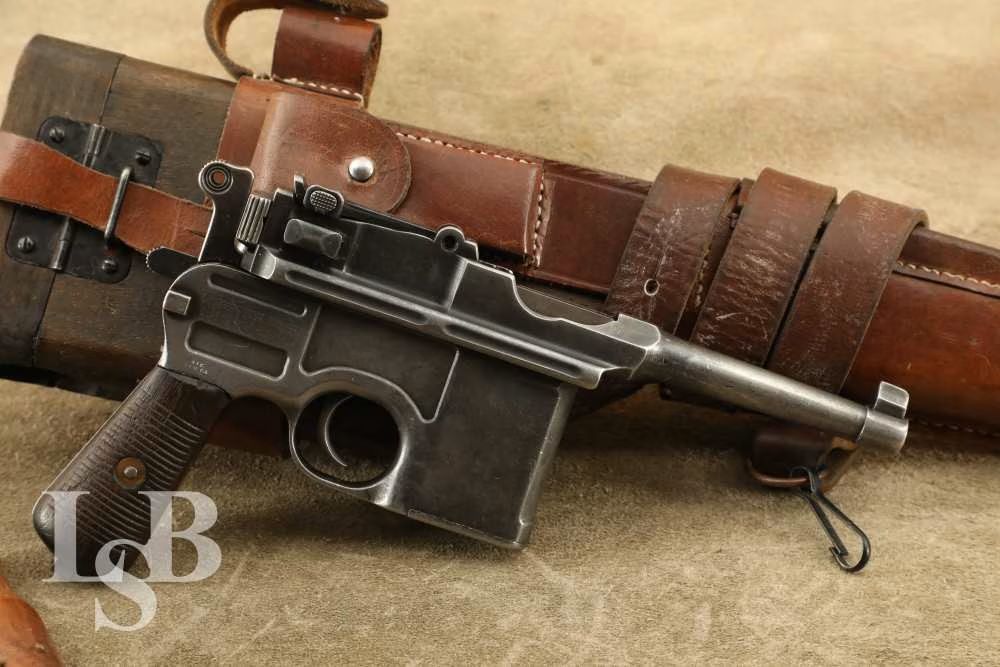
German C96 Mauser Broomhandle Bolo 7.63x25mm Semi-Auto Pistol, C&R
SOLD FOR: $2,042.00
LSB#: LSB260624RL021
Make: Mauserwerke Oberndorf a/N, Germany
Model: Model C-96 Bolo
Serial Number: 653791
Year of Manufacture: 1923 – 1930 / C&R
Caliber: 7.63x25mm
Action Type: Single Action Short Recoil Semi–Auto Pistol with Internal Magazine
Markings: The side of the barrel extension is marked with the serial number, “653791” and, “WAFFENFABRIK MAUSER OBERNDORF A/N”. Not all serialized parts are matched to the receiver. The right side of the frame is marked, “WAFFENFABRIC MAUSER OBERNDORF A.NECKAR” and the left side is marked with the Mauser banner. The holster is non-matched.
Barrel Length: 3 7/8”
Sights / Optics: The front sight is a barleycorn blade integral to a rectangular base fixed to the barrel. The rear sight is a V-notch rear sliding elevator with markings from “50-1000” that is pinned to the receiver.
Stock Configuration & Condition: The grips are two-piece ribbed wood panels. There are heavy pressure dents and scratches throughout along with a few small chips. There are no cracks. The ribs are worn. Overall, the grips are in about Fair condition.
Type of Finish: Blued
Finish Originality: Original
Bore Condition: The bore is gray and the rifling is heavily worn. There is very heavy erosion in the bore along with moderate pitting. In this writer’s opinion the bore rates at a 4/10.
Overall Condition: This pistol retains about 20% of its metal finish. There is heavy thinning, wear, tiny pitting marks, and spots of patina throughout. The grip screw is tooled, the pins are moderately tooled. The markings are worn and filled in. Overall, this pistol is in about Fair condition.
Mechanics: The action functions correctly. We did not fire this pistol. As with all used firearms, a thorough cleaning may be necessary to meet your maintenance standards.
Box, Paperwork & Accessories: Wooden holster w/ leather straps, cleaning tool, 1x stripper clip.
Our Assessment: The Mauser C96 Bolo takes its nickname from “Bolshevik,” a nod to the large numbers of the type bought by, or appropriated from the enemies of, the early Soviet state in the 1920s, and to the Red Army milieu that standardized its cartridge as the 7.62x25mm Tokarev in 1930. The Bolo was Mauser’s postwar answer to a changed market: from 1921 to 1930 the Oberndorf factory built the C96 in compact commercial form, with a 99mm (3.9-inch) barrel, reduced grip profile, small-ring hammer, the “New Safety,” six-groove rifling, and the 50 to 1000 meter tangent sight, while keeping the classic short-recoil locked-breech action and ten-shot internal magazine. Collector estimates put postwar Bolo output at about 345,000 of roughly a million C96 pistols, though the compiler of that production table warns its serial data is ‘highly suspect,’ and Mauser had built more than a million C96 pistols by 1939. Serial 653791 falls within the collector-estimated postwar range of roughly 445,000 to 790,000, though that table’s compiler warns the serial data is ‘highly suspect.’ This pistol carries the Mauser banner mark on the left of the frame.
The Bolo’s history is inseparable from the turbulent 1920s. The pistols sold in quantity into the contested Baltic region, carried by Polish, Lithuanian, German Freikorps, and White Russian hands, and they flowed east into Russia and south into China, where the C96 was so ubiquitous that the Chinese called it the “box cannon” and made it the primary service pistol of their military and police, a distinction no other country gave the type. Chinese, Spanish, and domestic copies eventually undercut Mauser’s own sales, but the original Oberndorf guns served on through the Second Sino-Japanese War and the Chinese Civil War. The C96 family also boasts some of the most famous individual users in firearms history: Winston Churchill carried a privately purchased C96 at Omdurman in 1898 and again in the Second Boer War, T.E. Lawrence carried one in the Sinai and Palestine campaigns, and the type was in the hands of everyone from Chinese communist general Zhu De to the perpetrators of the 1918 Ekaterinburg murders.
This example retains approximately 20% of its original blued finish and remains in Fair condition. The metal shows heavy thinning, wear, small areas of pitting, and scattered patina throughout. The grip screw is tooled, the pins show moderate tooling, and the markings are worn and partially filled but remain identifiable. The ribbed wood grip panels show heavy pressure dents, scratches, several small chips, and substantial wear to the ribs but remain free of cracks, rating in Fair condition. The bore is gray with heavily worn rifling and exhibits very heavy erosion with moderate pitting, rating 4/10 in this writer’s opinion. The serialized components are not all matching, and the wooden holster is likewise non-matching. Mechanically, the action functions correctly. For the Mauser collector, the correct compact barrel, Mauser banner, 1000-meter tangent sight, and period wooden holster, cleaning tool, and stripper clip preserve the essential character of the classic Postwar Bolo despite the mismatched numbers and hard service wear.