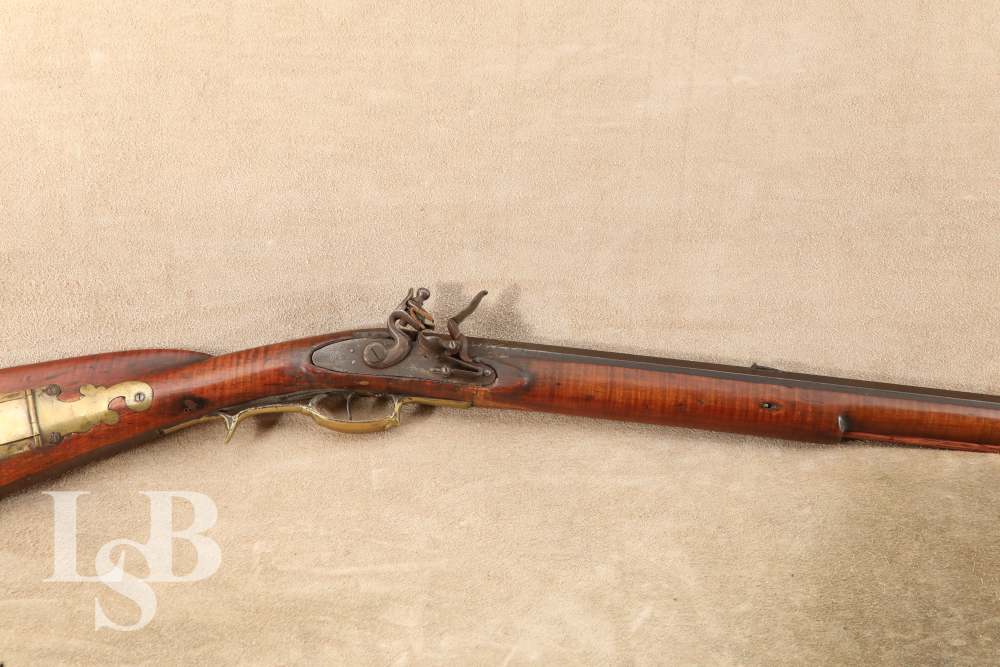
Pennsylvania Style .60 Caliber 42.5″ Flintlock Long Rifle Antique
SOLD FOR: $1,025.00
LSB#: LSB260622FM284
Make: Unmarked
Model: Pennsylvania Style Long Rifle
Serial Number: NSNV
Year of Manufacture: Unknown / Antique
Caliber: .60 Caliber
Action Type: Single Shot, Flintlock Muzzleloader
Markings: There are no legible maker or serial number markings.
Barrel Length: 42.5″, Octagonal
Sights / Optics: The front sight is a low blade dovetailed into the barrel. The rear sight is a fixed notch sight dovetailed into the barrel.
Stock Configuration & Condition: The full-length wood stock has a straight wrist, a raised cheekpiece on the left, a brass patchbox with a scroll-shaped finial on the right, and a curved brass buttplate. The forend has a brass nose cap and brass ramrod pipes. A brass-tipped wooden ramrod is installed beneath the barrel. The wood has dark transverse striping, scattered scratches, small impressions, and handling wear. There are cracks along the forend, chips around the stock pins, a toe crack held together by the buttplate, and a crack at the upper tang. The LOP measures 11.75″ from the front of the trigger to the rear of the buttplate. The stock is in Fair to Good condition as an Antique.
Type of Finish: Brown with Brass Furniture
Finish Originality: Original
Bore Condition: The bore is dark. There is moderate erosion in the bore. In this writer’s opinion, the bore rates 5/10.
Overall Condition: This rifle retains about 90% of its metal finish. The barrel and lock have dark brown surfaces with scattered small scratches, edge wear, and light pitting. There are patches of wear around the breech and lock. The brass has tarnishing, scratches, and handling marks. The screw heads show tool marks. The rifle is in Good condition as an Antique.
Mechanics: The action functions correctly. The cock holds at half and full cock.
We did not fire this rifle.
As with all used firearms, a thorough cleaning may be necessary to meet your maintenance requirements.
Box, Paperwork & Accessories: None
Our Assessment: Pennsylvania longrifle design often passed from master to apprentice, carrying the habits of one workshop into the next generation. Leonard Reedy, for example, trained under John Bonewitz before joining him in a Pine Grove gun shop around 1808. The Metropolitan Museum of Art’s Reedy rifle, dated about 1815, shows the influence of that training alongside Reedy’s own choices as a craftsman. This personal transmission of skills helps explain the family resemblances among regional longrifles: the shape of a cheekpiece or the treatment of a brass patchbox could carry a workshop tradition beyond the career of its founder.
The patchbox on this Pennsylvania-style rifle makes that aspect of the craft especially tangible. Its rectangular lid is surrounded by fitted brass, with a scroll-shaped finial extending into the buttstock; the decoration is built into the outline of the fitting. The raised cheekpiece and curved buttplate likewise required the stock and its mounts to be treated as a coordinated whole. Surviving workshop accounts show that gunmakers could obtain locks and barrels from specialist suppliers, leaving the stocker to bring those components together. Much of a longrifle’s regional character therefore took shape at the stocking bench, where separate metal components became a complete, fitted arm.