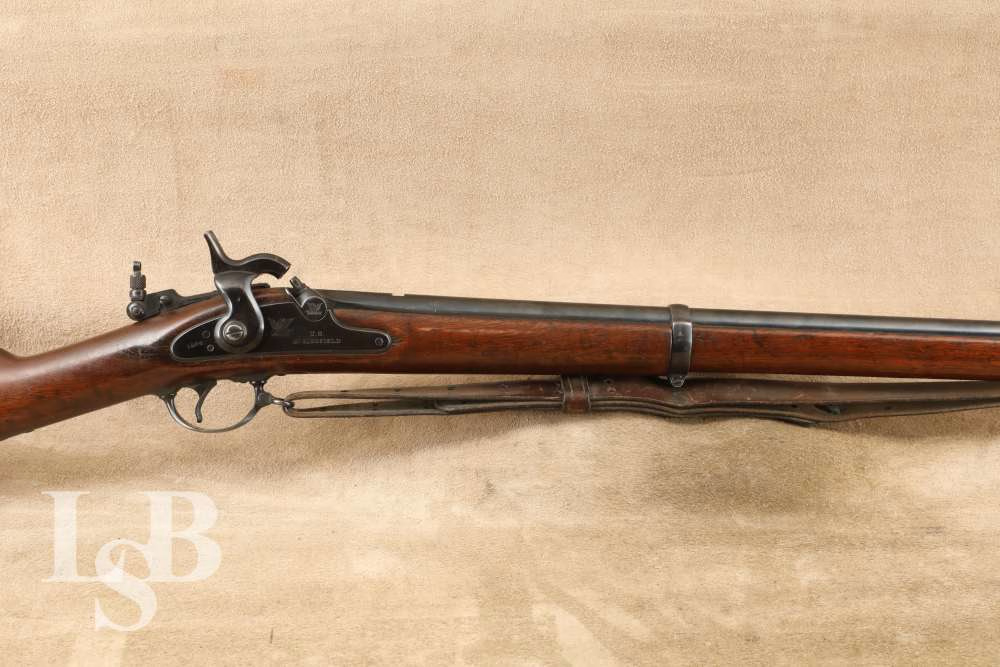
Springfield 1863 Musket Type II .58 Cal Civil War Era Rifle 1864 Antique
SOLD FOR: $1,136.00
LSB#: LSB250916OL001
Make: Springfield Armory
Model: 1863 Rifled Musket Type II
Serial#: NSNV
Year of Manufacture: 1864
Caliber: .58 Caliber
Action Type: Percussion, Muzzle Loading, Black Powder
Markings: The lock plate is marked “U.S. / SPRINGFIELD”, “1864”. The top of the barrel is marked “1864”. The right side of the stock bands are marked “U”.
Barrel Length: 40”
Sights/ Optics: The front sight is a blade integral to a rectangular block at the muzzle. The front sight appears to have been filed and had bead soldered in. The rear sight dovetail is empty. There is a modern Lyman tang peep sight added.
Stock Configuration & Condition/ Grip: The stock is one piece walnut with lock plate, straight grip, straight comb, metal buttplate, three barrel bands with springs, sling ring in the bottom of the middle band, nose cap, cutout for the included ramrod, sling ring in the front of the trigger guard. The LOP measures 13 1/2″ from the front of the trigger to the rear of the buttplate. There are scattered handling marks and nicks. The stock has been partially cleaned up and refinished. The stock rates in Good condition.
Type of Finish: Blued
Finish Originality: Refinished
Bore Condition: The bore is bright and the rifling is defined. There is very little erosion throughout. In this writer’s opinion the bore rates 9/10.
Overall Condition: This rifle appears to have been reblued at some point in the past. There is minor blurring along some of the stamping and inspection marks. The stock tip is discolored consistent with haveing been salt blued. The screw heads are tool marked with serviceable slots. Overall, this rifle rates in Good condition for a refinish.
Mechanics: The hammer locks. The trigger is crisp. The action functions correctly. We have not fired this rifle. As with all used firearms, a thorough cleaning may be necessary to meet your maintenance requirements.
Box Paperwork and Accessories: This rifle comes with its installed ram rod.
Our Assessment: The Springfield Model 1863 occupies a pivotal place in Civil War small-arms history as the culmination of mid-war efforts to simplify, standardize, and speed American military production. Evolving from the earlier Model 1861 and the transitional “Special” contracts, the Model 1863 standardized practical refinements—contoured hammer, flat milled bolster, simplified three-band stock and service fittings—so armories and subcontractors could turn out serviceable, interchangeable weapons by the tens of thousands. Springfield Armory, acting as the federal ordnance center, supervised production and inspection while relying heavily on private contractors to meet wartime demand; the result was a rifle-musket that became the ubiquitous service arm for Union infantry in the war’s later years.
The Type II (often called the 1864 variant) represents a conscious rollback of a few Type I experiments and a practical course-correction driven by service experience. Whereas the Type I had eliminated band springs in favor of screw-clamped oval bands and adopted a shorter bolster and other refinements, the Type II reintroduced band springs while keeping many of the Model 1863’s improvements; it also reverted the sighting geometry toward a simpler single-leaf arrangement in later runs.
The widespread adoption of the .58-caliber Minie-type projectile and rifled bores transformed the musket from a close-range smoothbore into a more accurate, longer-ranged infantry weapon, reshaping tactics, battlefield engagements, and casualty patterns. The Model 1863 therefore represents not only a manufacturing story—standardization, inspection marks, and government cartouches—but also the technological and doctrinal shift of mid-19th century warfare from traditional smoothbore volleys toward rifled, aimed fire at extended ranges. For collectors and historians, an 1863 Springfield is valued less as a singular luxury and more as a direct artifact of industrialized armament and the Union’s logistical response to total war. Despite this rifles refinish it remains in good condition. If you are looking for a historical shooter this rifle could be for you. Please see our photos and good luck on your bid! – MF