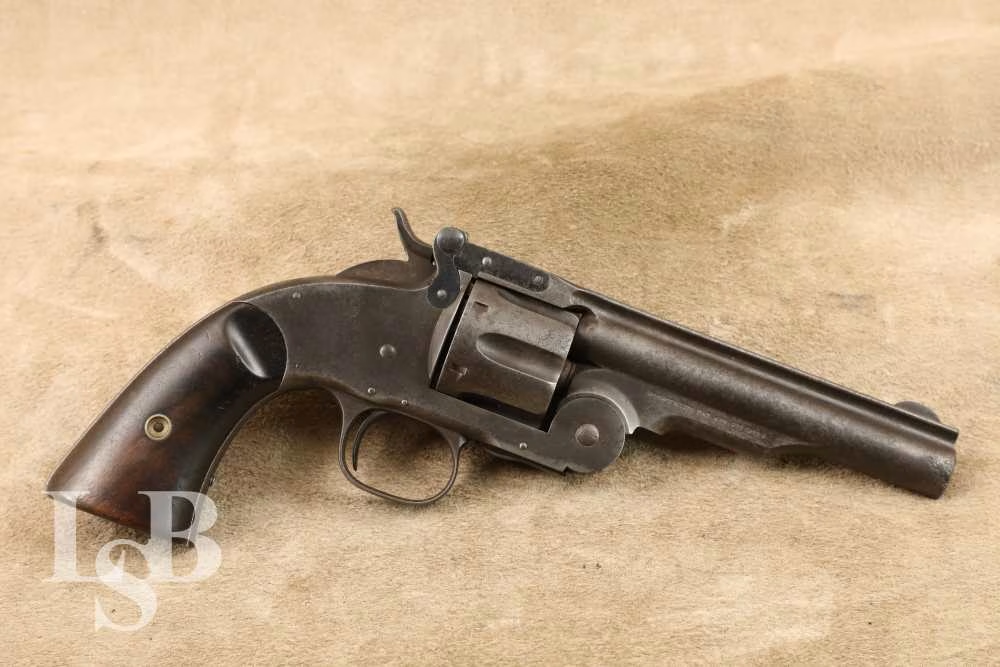
Smith & Wesson 2nd Model Schofield .45 S&W 5” Top-Break U.S. Army Revolver
SOLD FOR: $2,626.00
LSB#:LSB250731EK183
Make: Smith & Wesson
Model: Second Model Schofield
Serial Number: 3348
Year of Manufacture: Circa 1876–1877 Antique
Caliber: .45 S&W (Schofield)
Action Type: Single Action Top-Break Revolver with Automatic Extraction
Markings:
The left side of the barrel lug is marked “SMITH & WESSON SPRINGFIELD MASS. U.S.A. PAT. JAN. 17 & 24, 65 JULY 11, 65 AUG. 24, 69 JULY 25, 71”. The right barrel lug is marked “SCHOFIELD’S PAT. APR. 22D 1873”. The butt of the grip frame is stamped “U.S.” and the serial number “3348”. Matching numbers “3348” are found on the rear face of the cylinder, under the grip panels, and on the inside of the right walnut grips. The rear face of the cylinder is additionally proofed with a “P” and “W”, and the same “W” inspector’s mark is visible beneath the barrel catch on the frame. These are consistent with Springfield Armory acceptance proofs and military inspection marks from the 1876–1877 production period.
Barrel Length: 5” (Originally 7”)
Sights / Optics:
The front sight is a rounded blade forged to the barrel rib. The rear sight is a notch integral to the barrel latch.
Stock Configuration & Condition:
The grips are smooth walnut with a square butt profile and brass grip screw escutcheons. Both grips are numbered “3348” internally to match the revolver. There are no visible cartouches, which is common on examples that saw long service or post-issue refinishing. The grips show moderate handling wear, with minor chips, shallow dings, and flattened edges from use. There are no major cracks. The grips rate in about Good condition for their age and originality.
Type of Finish: Originally Blue, Now an Aged Patina with Approximately 5% Finish Retained
Finish Originality: Original (cut-down barrel alteration)
Bore Condition:
The bore is dark with defined rifling and visible erosion throughout. In this writer’s opinion, the bore rates 5/10.
Overall Condition:
This revolver retains about 5% of its original finish, primarily in protected areas near the hinge and barrel latch. The balance has turned to a gray-brown patina with light to moderate pitting on the frame and heavy pitting near the muzzle. The markings remain legible. The latch, hinge, and ejector all function correctly. The screw heads are serviceable but show some slot wear. The overall metal surfaces display even age and authentic wear consistent with field use and later modification. The revolver rates in about Good–Antique condition.
Mechanics:
The action operates correctly in single action. The top-break latch and automatic extraction mechanism function as intended, and cylinder timing appears proper. We did not fire this revolver. As with all used firearms, a thorough cleaning may be necessary to meet your maintenance requirements.
Box, Paperwork & Accessories: None
Our Assessment:
This U.S.-issued Smith & Wesson Second Model Schofield, serial number 3348, was manufactured circa 1876–1877 as part of the U.S. Army’s adoption of the Schofield design. Named for Major George W. Schofield, who improved Smith & Wesson’s No. 3 top-break system for mounted cavalry use, this revolver represents one of the most mechanically sophisticated and historically important American handguns of the 19th century. Its defining feature—the spring-loaded latch allowing the revolver to break open and simultaneously eject spent cartridges—gave the Schofield a tangible advantage over the Colt Single Action Army for rapid reloads on horseback.
The revolver is chambered in .45 S&W (Schofield), a slightly shorter and less powerful cartridge than the .45 Colt, but one which could be safely interchanged among Schofields and later Army Colts with modified cylinders. This cartridge became standard U.S. Army issue during the late 1870s, noted for its controllable recoil and smooth operation. As detailed in Supica & Nahas, Standard Catalog of Smith & Wesson, approximately 5,934 Second Model Schofields were manufactured for government service between 1876 and 1877, all originally with 7-inch barrels. Many were later sold as surplus and cut to 5 inches—like this example—for use by Wells Fargo, express agents, and civilians during the Western expansion period.
While this revolver shows honest wear from service and time, it remains a matching-number, U.S.-stamped, and inspector-marked piece of American frontier and cavalry history. The presence of the “P” proof and “W” inspector stamp confirms ordnance acceptance, and its cut-down barrel aligns it with the countless Schofields that saw renewed life beyond military issue. For collectors of U.S. martial arms or Old West handguns, this revolver stands as a tangible link to a short but storied chapter in American arms development—an era when Smith & Wesson competed directly with Colt for the Army’s sidearm contract.
KF