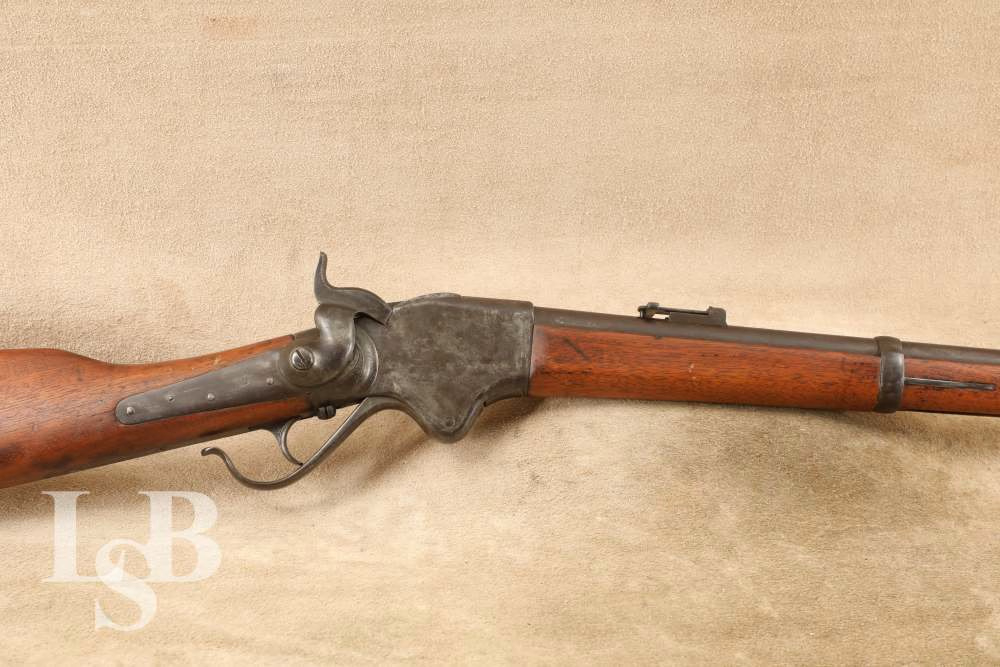
Rare US Indian Wars .56-50 Rimfire 32” Spencer Model 1871 Conversion Rifle
SOLD FOR: $1,975.00
LSB#: LSB250927CP004
Make: Spencer Repeating Arms Co.
Model: 1871 Conversion Rifle
Serial Number: 2164
Year of Manufacture: Circa 1865-1866, Antique
Caliber: .56-50 Spencer Rimfire
Action Type: Lever-Actuated Repeating Rifle with a butt-fed Tubular Magazine
Markings: The top of the receiver has a faded marking which reads “Model 1865” and “SPENCER REPEATING RIFLE CO / PAT’D MARCH 6 1860 / Manuf at Prov RI by Burnside Rifle Co”, and it features the serial number “2164”. The serial number “2164” is also marked on the left rear barrel. When these carbines were converted into rifles by Springfield Armory in 1871, they replaced the barrels and marked said barrels with the receiver’s serial number. It’s one of the distinguishing features of the Model 1871 Spencer conversion rifles.
Barrel Length: 32″
Sights/ Optics: The front sight is a blade fixed to a base by the muzzle. The rear sight is a ladder sight which presents a “V”-notch in the down position. When raised the ladder presents an integral “V’-notch at the top and a “V”-notch slider (the slider slides freely). The ladder is marked 2-8, inclusive.
Stock Configuration & Condition/ Grip: The stocks are two-piece wood featuring a forend that is secured by two barrel bands with a spring and screw, a straight comb and a metal butt-plate with a provision for the installed tubular magazine. The stocks have moderate handling marks, nicks and scuffs. There is a crack near the butt of the stock. The buttplate has gone to a deep patina with some corrosion. The LOP is 13” from the trigger to the rear of the butt-plate. It’s missing its rear sling swivel and saddle ring/bar. Overall, the stocks are in Good condition for Antique. The two barrel bands and provision for a saddle ring/bar also distinguish the Model 1871 Spencer conversion rifles.
Type of Finish: Blue and Case Color
Finish Originality: Original
Bore Condition: The bore is bright and gray with mostly sharp rifling. There are a few patches of light pitting and some erosion. In this writer’s opinion the bore rates 8/10 for antique.
Most antique firearms have bores that will show erosion. This is not only due to age but also to the use of black powder. When fired, black powder reacts corrosively. NRA Antique Firearm Conditions Standards are quite lenient for bores. In some cases, the NRA standards disregarded the bore’s condition for collector’s firearms.
Overall Condition: The rifle retains none of its metal finish. The gun is coated in scattered light-moderate surface oxidation which gives the gun a patina color. There are scattered patches of light pitting, light handling marks, nicks and scuffs. There is scattered erosion throughout. There has been some scrubbing to remove corrosion and some cold blue applied. The markings are legible. The screwheads are lightly tooled and remain serviceable. Overall, the rifle is in Good condition for an Antique.
Mechanics: The half cock engages. The action does not function correctly, as the magazine tube does not have a spring. The cleaning rod is missing. We have not fired this rifle. As with all previously owned firearms, a thorough cleaning may be necessary to meet your maintenance standards.
Box Paperwork and Accessories: None.
Our Assessment: “During the Civil War, the Union purchased about 12,000 Spencer rifles and many tens of thousands of carbines, and the weapon became a standard arm for the Cavalry service. After the war, thousands of Spencers were in warehouses and arsenals in need of refit either from combat damage or just abuse and neglect. Springfield Armory took on the job of repairing these weapons after the war. In February of 1871, the Armory commandant suggested that he had received a batch of about 1,100 Spencer carbines from Fort Leavenworth, and that he could refit them into infantry rifles. This plan was approved by the Ordnance Department, and a total of 1,109 conversions were produced in 1871.
The conversion work was done by replacing the Spencer barrel with a new three-groove 1868 model rifle barrel (32 or so inches long) and a 26 inch cleaning rod. Two barrel bands were used instead of the three on factory-original Spencer rifles. The wood and metal were refinished or repaired as necessary, and the receiver serial number (which could be anything from 1 to 34,000) was added to the left side of the barrel. If the carbine did not have a Stabler cutoff, one was added.” The preceding information graciously provided courtesy of the incomparable Forgotten Weapons.
On this example, the two-piece wood stock shows honest service wear with scattered handling marks, nicks, and scuffs, along with a crack near the butt. The metal buttplate has darkened to a deep patina with areas of corrosion, and the rifle is missing its rear sling swivel and saddle ring/bar.
The metal surfaces have worn entirely to a gray-brown patina with scattered oxidation, light pitting, and erosion throughout, with some evidence of past cleaning and localized cold blue application. The bore is gray-bright with mostly sharp rifling, showing light pitting and erosion, and rates 8/10 for an antique in this writer’s opinion. Mechanically, the half-cock engages, though the action does not function correctly due to the absence of a magazine spring. Overall, this is a fine example of a scarce, original Model 1871 Spencer conversion rifle. Please see our high resolution photos and good luck on your bid! MF/MA