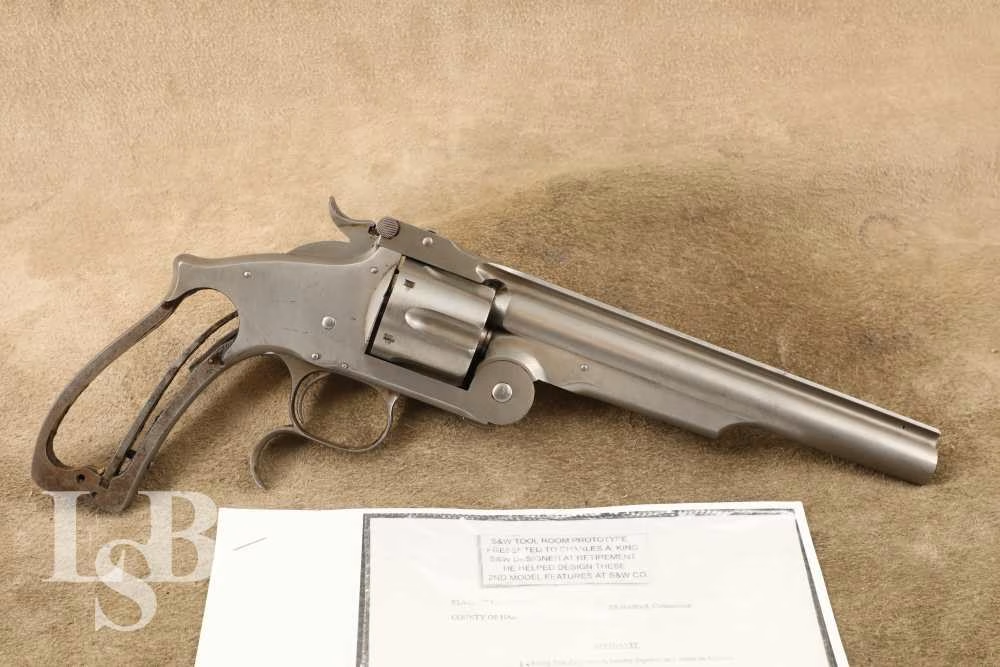
Antique Smith & Wesson S&W Tool Room 2nd Model Russian .44 Cal 7″ Revolver
SOLD FOR: $2,213.00
LSB#: 241110GS007.1
Make: Smith & Wesson
Model: Tool Room 2nd Model Russian (New Model Russian or Model No. 3 Russian, 2nd Model)
Serial Number: NSNV
Year of Manufacture: 1869
Caliber: .44 S&W Russian
Action Type: Single Action Revolver with Top Break Barrel
Markings: None.
Barrel Length: The barrel has a full-length top rib and 7” in length.
Sights / Optics: The front sight is not installed as one might expect with a tool room example. It is, however, machined and drilled to accept the blade we would expect to see. The rear sight is a “U” in a rise in the barrel latch.
Stock Configuration & Condition: There are no grips on this model and it was never completed outside of the tool room.
Type of Finish: In the White (Un-Finished)
Finish Originality: Original
Bore Condition: The bore is bright and the rifling is well defined. There is no erosion or pitting in the bore. This bore rates 10/10 in this writer’s opinion.
Overall Condition: This handgun retains about 99% of its original “in the white” metal finish. There are scattered spots that have oxidized. There is heavy oxidation on the sides of the grip frame. There are some little surface scratches from handling. There is a patina on the trigger guard. The screw heads are tool marked with serviceable slots. Overall, this handgun rates in about excellent condition.
Mechanics: The action works correctly. The cylinder lockup produces some side to side play. We did not fire this handgun. As with all used firearms, a thorough cleaning may be necessary to meet your maintenance standards.
Box, Paperwork & Accessories: Photocopies of biographical and historical documents accompanies the revolver including a notarized 2008 dated affidavit by the previous owner (a retired FBI Special Agent) attesting to the fact that Charles Alonzo King was his great-grandfather and that this was a tool room and property of King who retained it in his possession when he left Smith & Wesson in1874 to assume the duties of superintendent at Parker Bros. in Meridian, CT.
Our Assessment: This mechanically complete Second Model Russian revolver remains in the white, exhibiting visible milling and polishing marks with sharply defined edges and borders. No roll markings were ever applied. It features the distinctive “knuckle” trigger guard spur associated with the later Russian variants, and this example may represent the earliest known revolver to incorporate that feature. The hammer and trigger guard match the rest of the revolver, fabricated from soft, un-hardened steel and displaying a uniform dull grey patina, interrupted only by a few minor specks of freckling. The frame has been milled to accept a front sight, grip pins, and a lanyard swivel, yet none of these components were ever installed, reinforcing its status as an unfinished developmental example rather than a completed commercial arm.
Accompanying the revolver are photocopies of biographical and historical documents, including a notarized affidavit dated 2008 from the previous owner, a retired FBI Special Agent. The affidavit attests that Charles Alonzo King, his great-grandfather, retained this revolver as a tool room piece when he departed Smith & Wesson in 1874 to assume the role of superintendent at Parker Bros. in Meriden, Connecticut. The revolver descended through the family, having been given to the affiant by his grandfather, who was King’s son-in-law. The documentation establishes a compelling and continuous line of provenance directly to one of the most influential mechanical minds of the period.
Charles King, born in Franklin, Connecticut in 1837, began his career in machinery in Norwich before moving to Tracy & Brand, manufacturers of firearms and specialized equipment for the whaling trade. During the Civil War, he partnered with Otis A. Smith to produce musket components under government contract. In 1867, he became superintendent of Smith & Wesson in Springfield, where his administrative skill and engineering talent flourished. King held numerous patents and worked closely with Daniel Wesson on development of the large-frame No. 3 revolvers. Most notably, he designed and patented the ratchet ejector system, later sold to Smith & Wesson, a mechanism that remains foundational to revolver design today. The Second Model Russian revolver embodied the design changes mandated by the Russian government, and production was barely underway when Parker Bros. successfully recruited King to oversee and modernize their shotgun operations. This example represents a documented tool room prototype from that pivotal transitional period in American arms development. The Smith & Wesson top break revolvers evolved into numerous models and sub-variants, each desirable in its own right, but a prototype directly connected to King stands apart as a singular artifact of design evolution. Please see our photos for a better understanding of condition and good luck with your bids! – L.S.