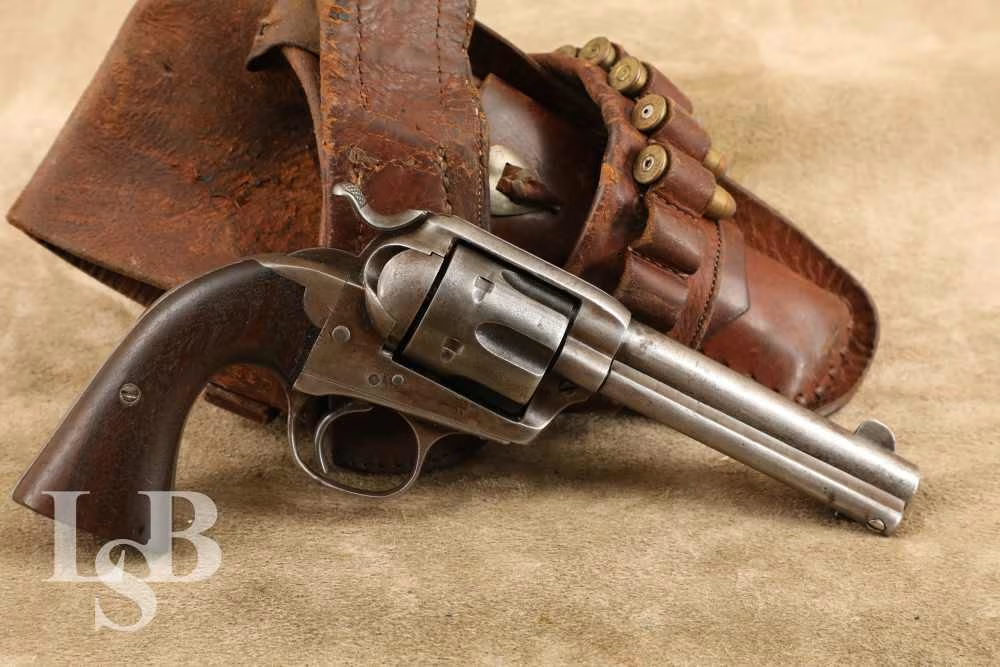
Colt 1st Gen. Single Action Army 4.75″ .38-40 WCF Bisley SAA Revolver 1900
SOLD FOR: $2,105.00
LSB#: LSB250824RD007
Make: Colt’s Patent Fire Arms Manufacturing Company
Model: Single Action Army, Bisley Model
Serial Number: 193114
Year of Manufacture: 1900 (per Colt factory serialization records; serial range 1900–1901) C&R
Caliber: .38 WCF (.38-40 Winchester Center Fire)
Action Type: Single Action Revolver with Side Loading Gate and Six-Round Cylinder
Barrel Length: 4 3/4 Inches
Markings: The left side of the barrel is roll-marked “(BISLEY MODEL) 38 W.C.F”. The top of the barrel is marked “COLT’S PT. F.A. MFG. CO. HARTFORD, CT. U.S.A.” The left side of the frame bears the three-line patent dates “PAT. SEPT. 19. 1871. / JULY 2. -72. JAN. 19. -75.” alongside the Rampant Colt emblem. The serial number “193114” is found on the frame, trigger guard, and backstrap, all matching. The hammer spur shows the characteristic Bisley checkering and downward angle.
Sights / Optics: The front sight is a fixed blade forged integrally to the barrel. The rear sight is a simple groove cut into the top strap.
Stock Configuration & Condition: The two-piece walnut replacement grips show age, handling, and use consistent with the revolver’s working life. The left panel displays a repair at the toe—solid, functional, and historically sympathetic. The grips show no major chips or modern refinishing, and they fit the frame properly, indicative of age.
Type of Finish: Originally blued with color case-hardened frame and hammer; now an overall aged gray patina with small areas of protected finish beneath the trigger guard, on the hammer base, and in the cylinder flutes.
Finish Originality: Original
Bore Condition: The bore is semi-bright with well-defined rifling and light pinprick erosion throughout. In this writer’s opinion, the bore rates 7/10.
Overall Condition: This Colt Bisley retains only traces of original finish, showing uniform silver-gray patina and age-darkened steel across most surfaces. The edges remain reasonably sharp, with honest holster wear rather than abuse. The screw heads remain serviceable with mild turning wear. Mechanically, the revolver locks up solidly and functions correctly. The overall condition rates about 5-10% of its original finish retained.
Mechanics: The action functions correctly. The hammer cocks solidly, the cylinder times properly, and the ejector rod operates as intended. We did not fire this revolver. As with all used firearms, a thorough cleaning may be necessary to meet your maintenance requirements.
Accessories: The revolver includes a period single-loop leather holster and cartridge belt with eight, spent primer, .38-40 display rounds tucked into the loops. The holster exhibits heavy but stable wear with evidence of multiple repairs—some old leather stitching, some replaced with twine—and features a silver heart concho on the pouch. A wonderfully evocative piece of frontier leatherwork that perfectly complements the revolver.
Our Assessment:
The Colt Bisley Model was introduced in 1894 as a specialized target and competition variant of the legendary Single Action Army. It was named after the Bisley Ranges in England, the home of international marksmanship contests, and featured a uniquely shaped grip frame, lower hammer spur, and wider trigger for improved control and accuracy. Fewer than 45,000 Bisleys were made between 1894 and 1915, with the majority chambered in .32-20, .38-40, and .45 Colt—making this .38 WCF example both classic and collectible.
By 1900, the American West was fading into memory, but men still carried Colts as tools of work and defense. The .38-40 Winchester Center Fire, first introduced in 1879, was a black-powder bottleneck cartridge later loaded with smokeless powder, delivering around 950 feet per second with a 180-grain bullet—fast and flat enough for both the trail and the ranch. The Bisley’s distinctive downward-curved hammer and slanted grip made it a favorite among marksmen and working lawmen alike.
This revolver’s gray patina and honest wear tell of decades of use—likely holstered on horseback or hung beside a ranch bunk. The remaining hints of color case-hardening and the matching serials across frame, trigger guard, and backstrap speak to originality. The inclusion of a well-worn leather holster and cartridge belt, complete with its silver heart ornament and empty shells, adds a striking sense of life and continuity to the piece—an artifact not just of Colt craftsmanship, but of the enduring American frontier.
KF